




Red light-activated anti-cancer treatment
By : Michael Gibb
The failure of drugs used in chemotherapy to target cancer cells with a high degree of accuracy has been a great cause for concern for some time. Like a shotgun, these drugs blast away at the growth of a malignant tumour but in the process impair healthy cells, too.
But an anti-cancer chemical compound developed by Dr Zhu Guangyu, Associate Professor in the Department of Chemistry, offers hope for minimising the degree of damage that “normal” cells undergo during cancer treatment.
“Phorbiplatin, the new chemical compound we’re working on for tackling cancer, shows great promise,” explains Dr Zhu, who researches anti-cancer drug development, drug mechanism and target validation, drug delivery, photodynamic therapy and chemical biology. A US patent for phorbiplatin is currently pending.
“This new treatment offers a more efficient and effective means to trigger anti-cancer drug activation in the tumour,” he says.

The process makes use of red light to fight tumours, a form of treatment that has gained prominence in recent years. It works like this. Dr Zhu and his team functionalise the anti-cancer drug oxaliplatin with a photoabsorber that is highly sensitive to red light. The photoabsorber is then activated using low intensity red light that activates the anti-cancer agents in the body.
Red light is favoured because it enables deeper penetration and doesn’t harm non-cancerous cells, whereas ultraviolet light has a relatively weaker penetration capacity and can damage cells.
“Phorbiplatin is also very promising because when it is in the dark, for example when the agent is within the body, it remains inactive. Then, using low-power red-light irradiation, without resorting to any kind of external catalyst, the phorbiplatin can be activated,” says Dr Zhu.
 Phorbiplatin can be activated by low-power red-light irradiation.“Essentially phorbiplatin is the first small-molecule platinum (IV) prodrug that can be activated by a red light,” he adds. A prodrug is one that the body metabolises after it enters the body and becomes an active pharmacological drug. Platinum-based anti-cancer drugs including cisplatin and oxaliplatin are used in more than half of chemotherapy treatments in the clinic.
“It took us around three years to develop phorbiplatin,” says Dr Zhu, whose lab, the Zhu Group, focuses on what lies at the interface of chemistry and biology in the study of the mechanisms of anti-cancer drugs, especially metal-based drugs, and the development of innovative anti-cancer complexes, such as nanomedicine and chemo-immunotherapeutic agents.
“Getting the right balance of chemicals was the tricky part,” he says.
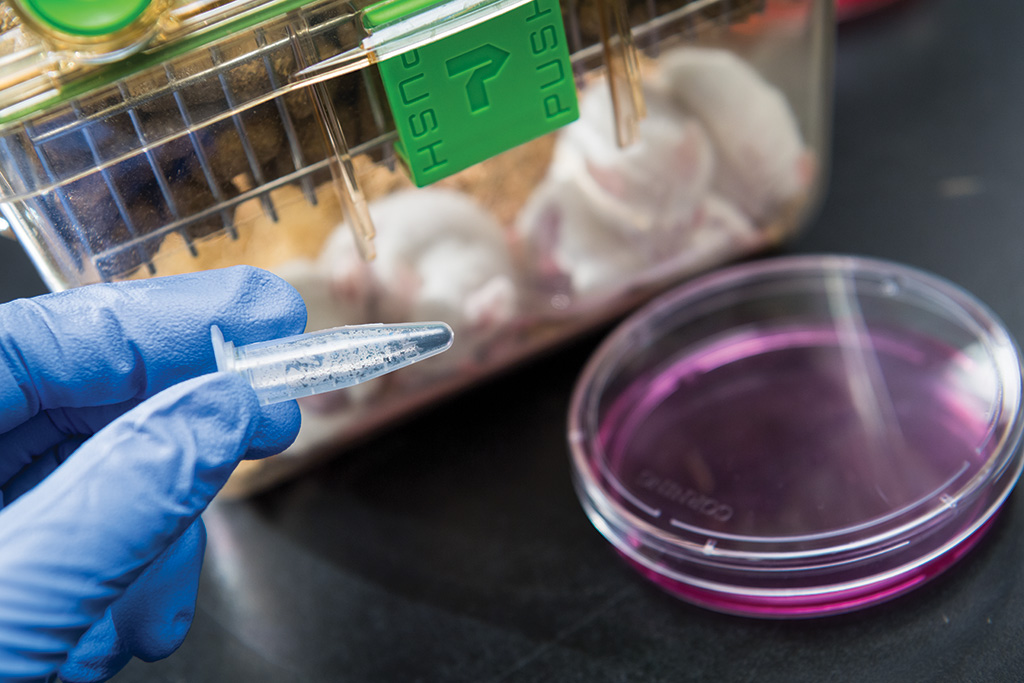
“This new treatment offers a more efficient and effective means to trigger anti-cancer drug activation in the tumour.” So far tests on mice have revealed good news. Dr Zhu’s new approach has “significantly improved anti-tumour activity”. Phorbiplatin triggered by red light appeared to result in a 67% reduction in tumour size and 62% reduction in weight compared with mice treated with oxaliplatin used in different forms and methods.
The CityU team also found that the major organs of the mice in the tests were in relatively good condition after treatment whereas mice treated with previous approaches using oxaliplatin suffered some side effects.
 Dr Zhu Guangyu (front) and his research team.“Our aim is to use this research to contribute to the development of photoactivatable anti-cancer drugs, especially those that can be activated by red light, and reduce the toxicity seen in traditional chemotherapy. The team will work on pre-clinical studies and conduct more toxicity tests as well as efficacy tests,” Dr Zhu says.
The research findings for phorbiplatin have been published in the scientific journal Chem. The other team members include PhD student Wang Zhigang; Dr Ko Chi-chiu and Dr Hajime Hirao, Associate Professors in the Department of Chemistry; Dr Shi Peng, Associate Professor in the Department of Biomedical Engineering; and CityU researchers Wang Na, Cheng Shun-cheung, Xu Kai, Deng Zhiqin, Chen Shu, Xu Zoufeng, Xie Kai and Tse Man-kit.

In addition to major breakthroughs in producing drug carriers for treating cancer and cell-based therapy for a more precise treatment of diseases such as cancer (see CityU Today #59), another stand-out project is the “Point of Care Devices – from Food Safety to Non-Invasive Early Cancer Detection” developed by Dr Roy Vellaisamy, Associate Professor in the Department of Materials Science and Engineering (MSE), and Professor Michael Lam Hon-wah from the Department of Chemistry, and their research team.
The project won a gold medal at the 47th International Exhibition of Inventions of Geneva in Switzerland in 2019.
The platform detects cancer biomarkers by, for example, non-invasive urine tests to screen for prostate cancer. This approach can help to increase the survival rate of patients with prostate cancer since early detection is crucial. The technology is based on a system developed by the CityU research team originally designed for the detection of contaminants in food.
 New biomarkers are also receiving a great deal of attention from other CityU teams. Using a genome-wide biomarker discovery approach, Dr Wang Xin, Associate Professor in the Department of Biomedical Sciences, has developed a novel 8-gene mRNA classifier for generating a more accurate detection of metastasis in patients with relatively early stages of colorectal cancer, one of the leading causes of cancer-related deaths worldwide. His team’s findings have been reported in Gastroenterology.
According to Dr Wang, he and his team are planning further studies to evaluate and validate the performance of the biomarker before their translation into clinical practice.
“We hope one day we can develop more precise diagnostic tools for colorectal cancer patients, so that they don’t have to suffer unnecessary surgery,” Dr Wang says.