 Facebook
 Instagram
 X
X LinkedIn
 Weibo
Weibo WeChat
 YouTube
 RedNote
William S-Y. Wang: Epoch-Making Linguist
Eastward flows the Great River;
With gushing waves it carries away
Gallant souls from days of yore.
— (Song dynasty) Su Shi
Browsing through volumes of the long history of linguistics, the pages glitter with familiar names. Many linguists have dedicated their lives and wisdom to the research of languages, the young talents taking up the works of the old ones and marching forward with force and energy on the path to explore the mysteries of languages. Among the linguists of the 20th century, an eminent name stands out: William S-Y. Wang.
Prof. William Wang is a pioneer in interdisciplinary linguistic studies and a distinguished scholar of evolutionary linguistics. He is a worldwide acclaimed master of linguistics and an epoch-making linguist.
The compilation of the Festschrift in Honor of William S-Y. Wang on his Eightieth Birthday has gained enthusiastic support from numerous linguists in Mainland China, Hong Kong, Taiwan, East Asia as well as in Europe and the United States. With a total of over sixty excellent contributions covering the major fields of contemporary linguistics, the Festschrift is divided into the Chinese and English volumes and is scheduled to be published on Prof. Wang's 80th birthday. This is an important event not only in the community of Chinese scholarship, but also in international linguistics. It is indeed a great honor to experience this historical event! Living in the present while evoking memories of the past, we cannot but feel an upsurge of excitement.
The title of the Festschrift, "Eastward Flows the Great River", has two implications: one is a metaphoric depiction of Prof. Wang's attitude in linguistic research, which resembles the rolling waves of the Yangtze rushing eastward, with its waters always flowing forward to finally empty into the ocean of knowledge. The other is to describe the boundless currents of contemporary linguistic studies which started in the West and continue towards the East with booming and innovative vitality. The verse "Eastward flows the Great River" by the Song dynasty poet Su Shi is both succinct and unadorned, but evokes an image of powerful grandeur. With these words the poet expressed his nostalgic sentiments towards the historic heroes, revealing a philosophical insight on the rise and fall of the ages. The power of his writing remains unexcelled to this day.
Our celebration of Prof. Wang's 80th birthday is not merely about recognizing his seminal contributions to linguistic studies, but also about identifying the goal and direction which he represents in contemporary linguistics. Whether viewed from the current global situation of international linguistics, or considered from the historical development of modern linguistics, Prof. Wang's research works on linguistics over the past fifty some years have given us precious inspirations. They also reflect the stride linguistics has made in more than half a century.
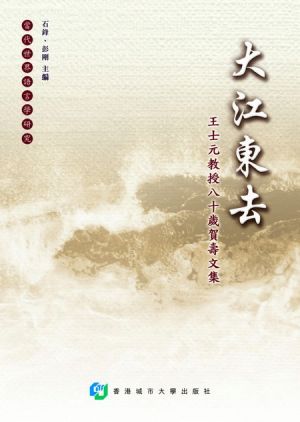
Eastward Flows the Great River— Festschrift in Honor of Professor William S-Y. WANG on his 80th Birthday
Author / Editor
Edited by PENG Gang, SHI Feng
HKD180.00
In stock
Professor William S-Y. Wang is among the most influential contemporary linguists. For several decades, he has been leading the development of Chinese Linguistics to a higher level. Professor Wang established the famous theory of lexical diffusion, advocating an evolutionary perspective and interdisciplinary methods for research on language and linguistics. His writings have appeared in handbooks, textbooks, encyclopedias, numerous technical journals, and have been translated into several languages.
On the occasion of his 80th birthday, numerous pupils and colleagues of Professor Wang come together for the compilation of the Festschrift to pay tribute to him. The Festschrift has over sixty contributions by scholars from Mainland China, Hong Kong, Taiwan, East Asia, North America and Europe, partitioned in Chinese and English volumes. Authors are active in areas of various linguistic frontiers, investigating language and linguistics from an interdisciplinary perspective. Most of the contributions investigate Chinese language via modern linguistic experiments, archeology, anthropology, psychology and modeling methods and so on, leading readers into new realms of linguistics.
This Festschrift shows the achievements of modern linguistics, reflecting Professor Wang's academic philosophy. It is not only a great reference for seasoned language researchers; it can also help broaden knowledge in Chinese linguistics for students interested in languages. Readers who wish to know Chinese culture will also expand their understanding of it through these studies of the languages in China.
On the occasion of his 80th birthday, numerous pupils and colleagues of Professor Wang come together for the compilation of the Festschrift to pay tribute to him. The Festschrift has over sixty contributions by scholars from Mainland China, Hong Kong, Taiwan, East Asia, North America and Europe, partitioned in Chinese and English volumes. Authors are active in areas of various linguistic frontiers, investigating language and linguistics from an interdisciplinary perspective. Most of the contributions investigate Chinese language via modern linguistic experiments, archeology, anthropology, psychology and modeling methods and so on, leading readers into new realms of linguistics.
This Festschrift shows the achievements of modern linguistics, reflecting Professor Wang's academic philosophy. It is not only a great reference for seasoned language researchers; it can also help broaden knowledge in Chinese linguistics for students interested in languages. Readers who wish to know Chinese culture will also expand their understanding of it through these studies of the languages in China.
ISBN
978-962-937-216-3
Pub. Date
Aug 1, 2013
Weight
1.14kg
Paperback
572 pages
Dimension
185 x
260 mm
Subjects
- How Many Chinese Words Have Elastic Length?
?—San DUANMU - More Gradual Than Abrupt
?—Umberto ANSALDO - Phonetic Features of Colloquial Cantonese
—Robert S. BAUER - Linguistic Adaptation: The Trade-Off between Case Marking and Fixed Word Orders in Germanic and Romance Languages
—Christian BENTZ, Morten H. CHRISTIANSEN - On the Value of the Han'gul Letter E in Certain Korean Transcriptions of Ming-Time Chinese
?—W. South COBLIN - Investigations into Determinants of the Diversity of the World╒s Languages
—Christophe COUPé, Jean-Marie HOMBERT, Egidio MARSICO, Francois PELLEGRINO - From Cognition to Language
—Hsin-I HSIEH - Arguments for a Construction-Based Approach to the Analysis of Sino-Tibetan Languages
—Randy J. LAPOLLA - The Language Niche
—Helena H. GAO, John H. HOLLAND - Contextual Predictability Facilitates Early Orthographic Processing and Semantic Integration in Visual Word Recognition: An Event-Related Potential Study
—Chia-Ying LEE, Yo-Ning LIU, Chia-Ju CHOU - Larynx Height and Constriction in Mandarin Tones
—Scott MOISIK, Hua LIN, John ESLING - Bimanual Coordination and Motor Learning in Pianists and Non-Musicians:? A 3T fMRI Study
—Shu-Jen KUNG, Denise H. WU, Daisy L. HUNG, Ovid J.-L. TZENG - Searching for Language Origins
—P. Thomas SCHOENEMANN - Productivity of Mandarin Third Tone Sandhi: A Wug Test
—Caicai ZHANG, Gang PENG - On Modality Effects and Relative Syntactic Uniformity of Sign Languages
—James H-Y. TAI - Visualizing the Architecture and Texture of a Text: A Case Study of Selected Speeches of US President Barack Obama
—Jonathan WEBSTER, Joe CHAN, Victor YAN, Kim WONG - Northern-Min Glottalized Onsets and the Principles of Tonal Split and Tonal Merger
—Weera OSTAPIRAT - Different Semantic Nature of Homonym, Metaphor and Polysemy in Mandarin Chinese: Evidence from Behavioral and Functional Magnetic Resonance Imaging Experiments
?—Fan-Pei YANG, Dai-Lin WU - A Few Morphological Functions of the Suffix *-s in Shang Chinese
—Ken-ichi TAKASHIMA - Computer Simulation of Language Convergence
—Tao GONG, Lan SHUAI, Umberto ANSALDO - On the Evolution of Language and Brain
—Sydney LAMB - On the History of Chinese Directionals
?—Alain PEYRAUBE - A Target Location Cue in a Visual Speller: The N200 ERP Component
—James William MINETT, Lin ZHOU, Manson Cheuk-Man FONG - Consensus in Language Dynamics: Naming, Categorizing and Blending
—Vittorio LORETO,? Francesca TRIA - Data Acquisition and Prosodic Analysis for Mandarin Attitudinal Speech
—Wentao GU, Hiroya FUJISAKI
Appendix????? An Interview with Professor William WANG
Related Titles