The scientists at the City University of Hong Kong (CityU) have announced a noteworthy breakthrough in the development of a passive radiative cooling (PRC) material.
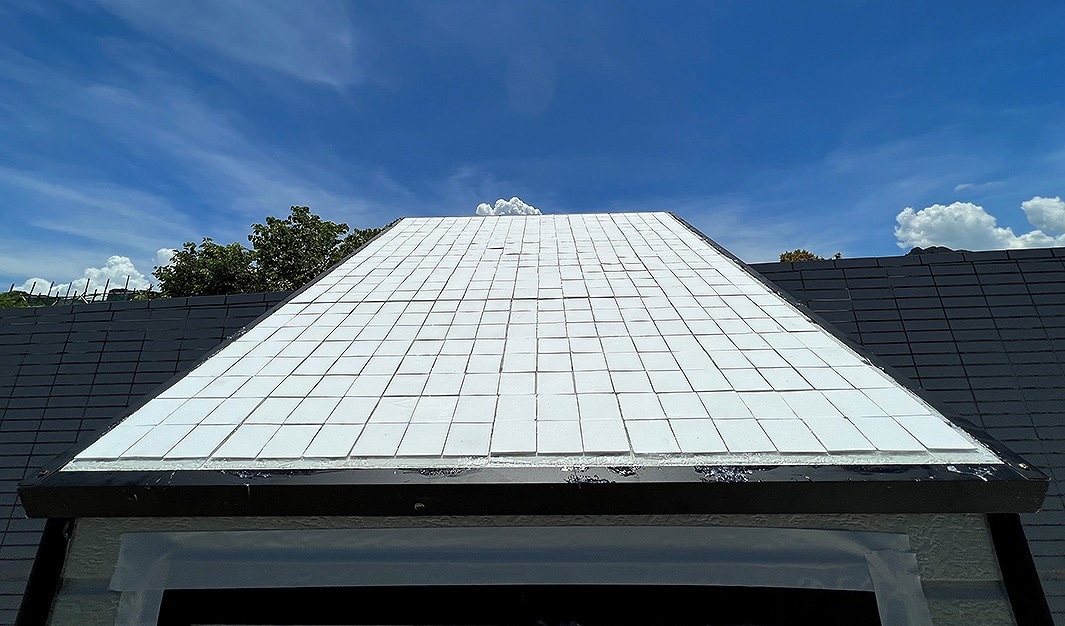
Application in a building envelope, with the white cooling ceramic applied on the roof. Image Credit: City University of Hong Kong
The findings have been published in the prestigious scientific journal Science.
The material, referred to as cooling ceramic, has demonstrated exceptional optical properties, enabling energy-free and refrigerant-free cooling generation. With its cost-effectiveness, durability, and versatility, this cooling ceramic material is deemed highly suitable for commercialization across various applications, especially in the field of building construction.
Cooling ceramic, by lowering the thermal load of buildings and ensuring consistent cooling performance across diverse weather conditions and climates, contributes to enhanced energy efficiency. This capability has the potential to play a role in combating global warming.
PRC is recognized as one of the most promising green cooling technologies, serving to address the escalating demand for space cooling, mitigate environmental pollution, and contribute to the fight against global warming. This perspective comes from Professor Edwin Tso Chi-yan, an Associate Professor in the School of Energy and Environment (SEE) at CityU and one of the corresponding authors of the paper.
Despite the potential of PRC using nanophotonic structures, the current implementations face limitations due to high costs and poor compatibility with existing end uses. Additionally, alternatives based on polymeric photonics lack weather resistance and effective solar reflection.
Enhanced Optical Properties and Applicability
But our cooling ceramic achieves advanced optical properties and has robust applicability. The color, weather resistance, mechanical robustness, and ability to depress the Leidenfrost effect - a phenomenon that prevents heat transfer and makes liquid cooling on the hot surface ineffective - are key features ensuring the durable and versatile nature of the cooling ceramic.
Edwin Tso Chi-yan, Associate Professor, City University of Hong Kong
The exceptional uniqueness of cooling ceramic is attributed to its hierarchically porous structure as a bulk ceramic material. This structure is easily fabricated using readily available inorganic materials like alumina through a simple two-step process involving phase inversion and sintering. The manufacturing process does not require delicate equipment or expensive materials, making it highly feasible for the scalable production of cooling ceramics.
The cooling performance of PRC materials relies on their optical properties within two wavelength ranges: the solar range (0.25–2.5 µm) and the mid-infrared range (8–13 µm). For effective cooling, it is essential to have high reflectivity in the solar range to minimize solar heat gain and high emissivity in the mid-infrared range to maximize radiative heat dissipation. The cooling ceramic, owing to the high bandgap of alumina, minimizes solar absorption, contributing to its efficiency in heat dissipation.
The cooling ceramic goes a step further by emulating the bio-whiteness of the Cyphochilus beetle and optimizing the porous structure based on Mie scattering. This design allows the cooling ceramic to efficiently scatter almost all wavelengths of sunlight, leading to near-ideal solar reflectivity of 99.6%, marking a remarkable high in solar reflectivity. Simultaneously, the material achieves a high mid-infrared thermal emission of 96.5%. These advanced optical properties surpass the capabilities of current state-of-the-art materials.
The cooling ceramic is made of alumina, which provides the desired UV resistance degradation, which is a concern typical of most polymer-based PRC designs. It also exhibits outstanding fire resistance by withstanding temperatures exceeding 1,000 °C, which surpasses the capabilities of most polymer-based or metal-based PRC materials.
Edwin Tso Chi-yan, Associate Professor, City University of Hong Kong
Outstanding Weather Resistance
In addition to its remarkable optical performance, the cooling ceramic showcases outstanding weather resistance, chemical stability, and mechanical strength, rendering it suitable for long-term outdoor applications.
Notably, at extremely high temperatures, the material exhibits superhydrophilicity, allowing for immediate droplet spreading and rapid impregnation of the droplets due to its interconnected porous structure.
This superhydrophilic property counteracts the Leidenfrost effect commonly observed in traditional building envelope materials, promoting efficient evaporative cooling.
The Leidenfrost effect is a phenomenon observed when a liquid encounters a surface significantly above its boiling point. Instead of promptly evaporating upon contact, the liquid establishes a vapor layer that shields it from direct interaction with the surface. This vapor layer diminishes the speed of heat transfer, making liquid cooling on the hot surface inefficient. Consequently, the liquid hovers and glides across the surface. In the realm of cooling materials, preventing the Leidenfrost effect is essential to enhance the efficiency of evaporative cooling.
“The beauty of the cooling ceramic is that it fulfills the requirements for both high-performance PRC and applications in real-life settings,” states Professor Tso. He adds that the cooling ceramic can be colored with a dual-layer design, reaching the aesthetic requirements as well.
Our experiment found that applying the cooling ceramic on a house roof can achieve more than 20% electricity for space cooling, which confirms the great potential of cooling ceramic in reducing people’s reliance on traditional active cooling strategies and provides a sustainable solution for avoiding electricity grid overload, greenhouse gas emissions and urban heat islands.
Edwin Tso Chi-yan, Associate Professor, City University of Hong Kong
In light of these discoveries, Professor Tso expressed the research team's intention to progress with additional passive thermal management strategies. Their objective is to investigate the implementation of these strategies to improve energy efficiency, advocate for sustainability, and broaden the accessibility and applicability of PRC technologies across diverse sectors. This includes potential applications in textiles, energy systems, and transportation.
Journal Reference
Lin, K., et al. (2023). Hierarchically structured passive radiative cooling ceramic with high solar reflectivity. Science. doi.org/10.1126/science.adi4725.