


Passing on Lessons from the Field
Dr CHAN Siu-ming spent eight years working in the community but is now back at the campus as a member of faculty and will help shape the University’s social work programme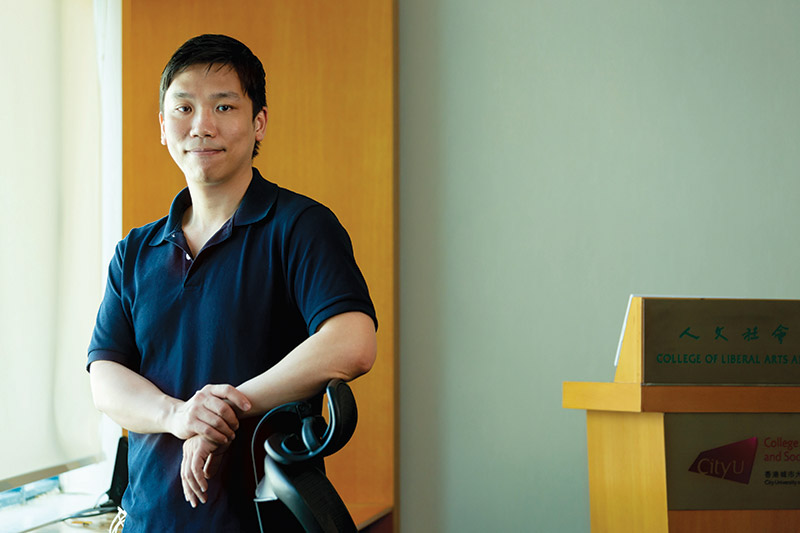
Chan hopes his research and surveys can compel the government to implement evidencebased measures to solve social problems.
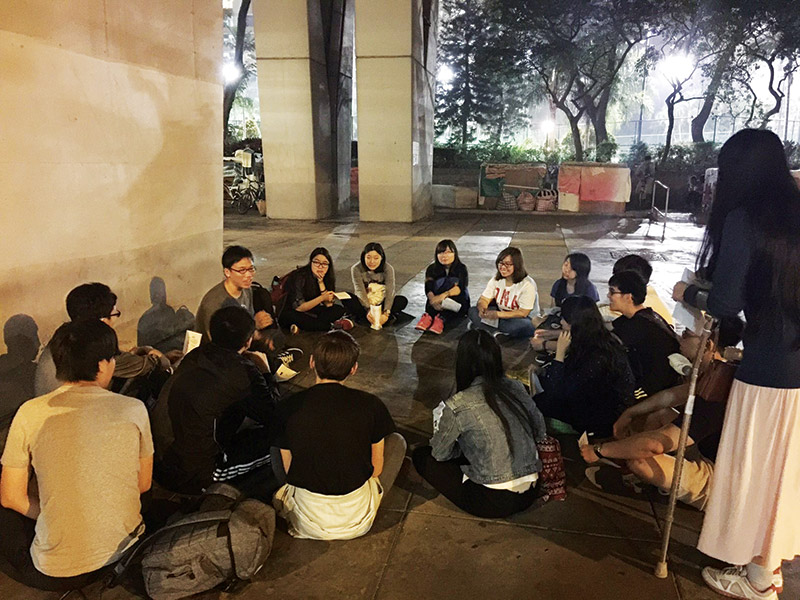
Chan did a debriefing with students after leading them to visit homeless people in Sham Shui Po.
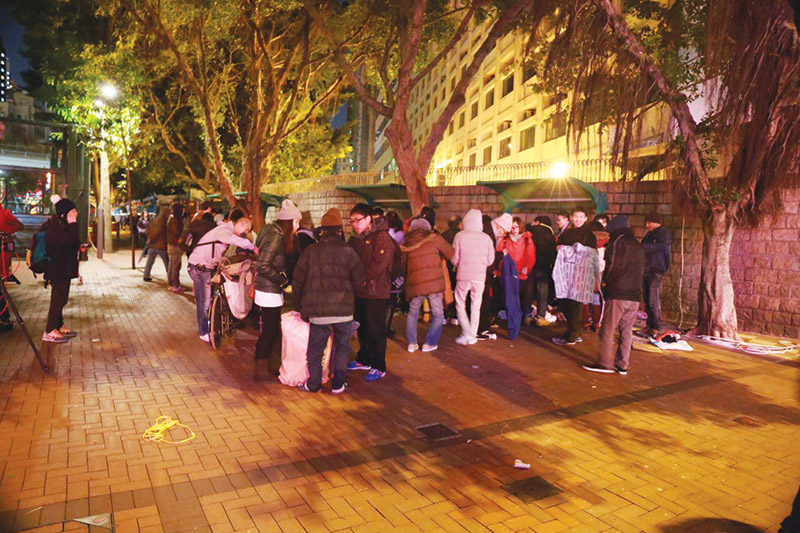
Chan worked with other volunteers on a cold winter night to deliver clothes to the homeless in Yau Tsim Mong District.
Dr CHAN Siu-ming admits that his story is a rather long one. Chan joined the social work profession after completing study in social work at university to serve the community in which he himself grew up. After eight years in the field, the now Assistant Professor at CityU’s Department of Social and Behavioural Sciences has decided to embark on an academic career and share his expertise with a new generation of frontline social workers.
Chan’s professional history includes serving the underprivileged, such as the homeless and low-income families living in subdivided flats or cubicles, the elderly and financially disadvantaged children. All these he did through direct service, group work and community organisations. His research interests include poverty, housing, and social work. His vision is to enhance the well-being of vulnerable groups.
Whenever there are needy and poor in society, we need to do something about that. From that starting point, we can think of different ways to help them
Dr Chan Siu-ming
His primary inspiration for going into research and teaching he says was the church. “Church activities left a large impact on me because I gained self-confidence and bravery while helping others in my church.” He was also heavily influenced by his childhood background. “I come from a low-income family, and in my childhood my family received welfare, but then the church really changed my personal life. It was quite simple. I just wanted to help people at that moment.”
During the three years he was an undergraduate, starting in 2005, he was influenced by a placement at the Society for Community Organisation. His main work there targeted cage home residents—those who lived in tiny cage-like cubicles. “Nowadays we call these subdivided units,” he says. “At that time, I was quite shocked by the different environment. I thought, why is this happening in Hong Kong? It is a financial centre, an international city. And yet, many people are living in such poor conditions. I decided to work as a social worker and did so for eight years.”
Embarking on a Journey of Teaching and Research
One could argue that Chan’s academic career started with those eight years. He began studying for a Master’s degree, and later in 2014, one of his teachers invited him to teach social work courses at local tertiary institutions. Doing this part time alongside his social work inspired Chan to embark on an academic career full-time.
“The experience inspired me to gain more knowledge and also equip myself to further teach in university,” he says. “There were two main reasons or goals for me to continue; one is for teaching itself, I want to teach social work students. The second goal is doing research as my career because my work will be more evidence-based and also gain some macro understanding of the essential problems, and the underlying factors of so-called social problems.”
Chan has since conducted policy research and surveys regarding vulnerable groups facing poverty and housing problems. In 2021 he joined CityU, aiming to explore new initiatives and devise intervention strategies based on analysis of social problems and human behaviour.
Chan believes large-scale surveys and analytics will compel the government to take evidence-based actions.
“Evidence provided by NGOs can be used by the government for setting policy,” he adds. “For example, when we say we want to deal with homeless people, at least we should know: who they are, where they live, and what the major problems are. From a survey, we understand that the mental health situation of homeless people is getting more serious. This informs the government that they should provide more outreach and mental health services to homeless people.”
Another example Chan points out is that the number of homeless people is increasing but the resources from the government are not increasing proportionately.
In his teaching, Chan mainly covers social policy, social welfare and community work. “In social policy, I teach students how to understand the situation of disadvantaged groups in Hong Kong, from some macro perspectives and theoretical approaches. I also teach community work that we need to work with residents and intervene in community problems with different approaches.”
Sowing Seeds of Hope
Asked about Hong Kong’s young population who are entering university, the assistant professor is hopeful. Young people these days, he explains, still have the willingness to help people, “they want to do something for the community in Hong Kong or other places”. Extensive training through placements and other work experiences remain crucial. But with students he has taught in mind, Chan feels optimistic, as many have developed their own distinct fields of interest within the social welfare discipline.
He adds, “It’s a joy to see the changes they undergo from Year One to Year Four. Their values remain the same—wanting to help the disadvantaged and tackle social inequality, but by the end, they are more equipped with knowledge and skills after social work training.”
It is a bittersweet experience for Chan when his students reach the end of the programme. “Sometimes I gain energy from the feedback of the students. Especially, at the end of the course, we talk about what they have learnt from the courses and I focus on simple questions from them, which always remind me to keep on teaching because it serves our society, the poor and needy.”
He admits the last two to three years have put a slight damper on university life across the globe due to the pandemic. “They have fewer opportunities to get in touch with disadvantaged groups. After the pandemic, I would encourage students to do more volunteering work to get in touch with the disadvantaged groups face to face.” Nevertheless, social work is special, Chan reminds us. It requires a lot of creativity and one must be capable of facing different challenges. “Whenever there are needy and poor in society, we need to do something about that. From that starting point, we can think of different ways to help them.”