


Pushing the Boundaries of Linguistics Research and Teaching
A trailblazer in neurolinguistics, Professor Niels SCHILLER avidly takes the lead in fostering collaboration and expanding the scholarly reservoir within CityUHK’s Department of Linguistics and Translation
For more than 30 years, Schiller has sought to unravel the mysteries of language cognition.
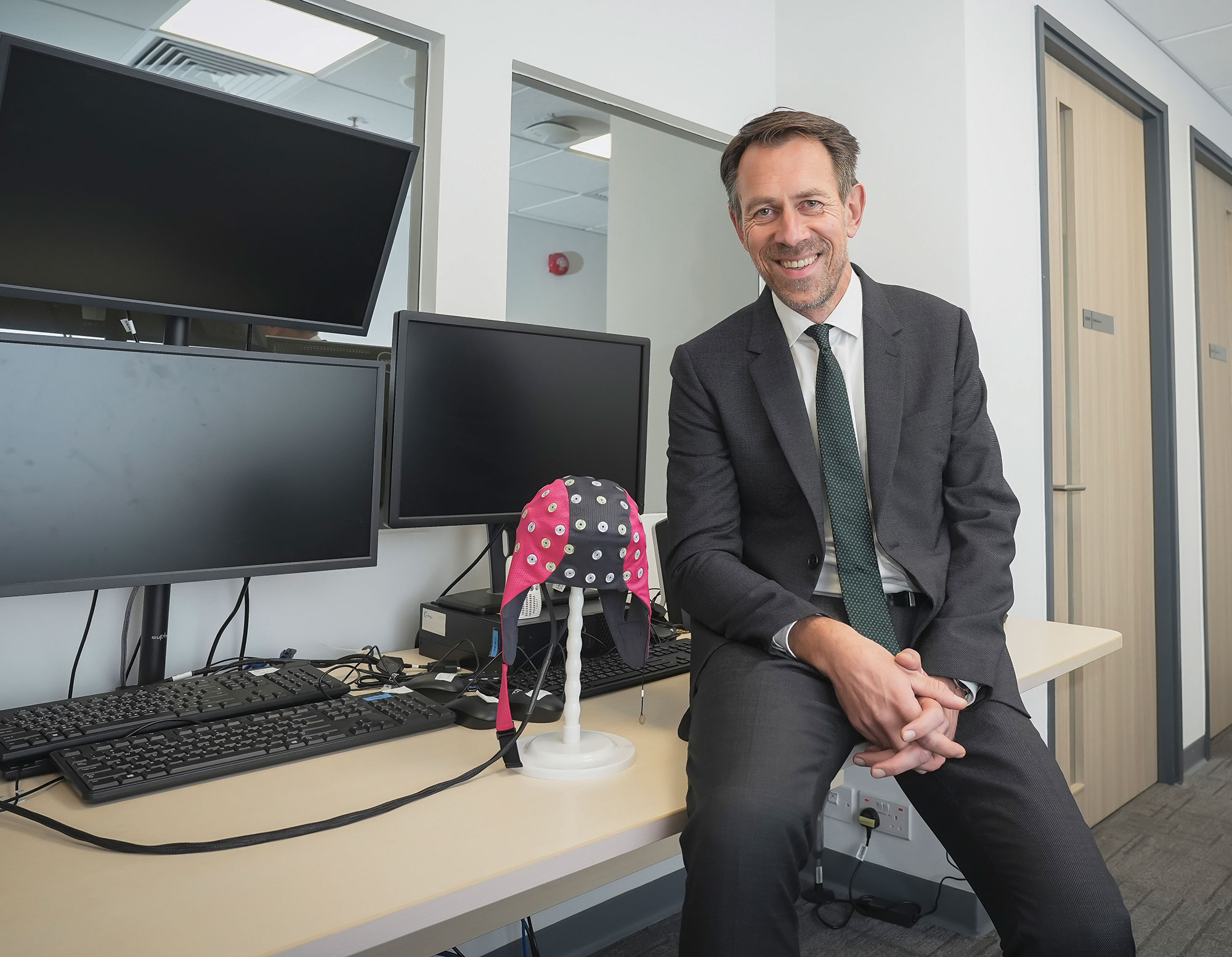
Schiller believes there are many opportunities for multidisciplinary collaborations across departments at CityUHK.
Nothing rivals the power and intricacy of language and communication in the vast realm of human existence. Understanding the intricate workings of the human mind and its relationship to language has always been the captivating pursuit of Professor Niels SCHILLER, who recently joined City University of Hong Kong (CityUHK) as Head of the Department of Linguistics and Translation (LT) and Chair Professor of Psycho- and Neurolinguistics.
“Language is a means to communicate, but it’s the most complex of cognitive skills that human beings have,” Schiller explains.
When humans use language, they are making use of their memory, motor, and executive functions, all part of an incredibly complex process. This is why talking can seem so exhausting, he adds.
“It’s so taxing on the cognitive system but also intriguing in the sense that there are still many open questions,” Schiller says.
Exploring those open questions has spurred Schiller’s more than 30-year career, marking him as a trailblazer in neurolinguistics. He has made it his personal mission to unravel the mysteries of language cognition and push the boundaries of linguistics research.
Raising the Bar
Today, he is bringing his research and expertise to CityUHK in the hope that he will be able to make positive contributions to both the fundamental research in the field and its relevant applications for society, as well as make an impact on his students.
“There is already a lot of expertise in the area of language processing available at the Department, but I’m hopefully here to raise the bar,” he says.
Indeed, Schiller notes that, for the most part, the study of linguistics has always taken a traditional research route. However, with the advent and advances in science and technology, he sees two areas that are now prime for development. One is in computational linguistics, which deals with the computational modelling of natural language and the application of interdisciplinary computational approaches to linguistic inquiries. The other area is experimental linguistics, which studies the relationship between language and the brain as well as how to develop that branch further.
“These are two areas in linguistics that have much potential both in terms of fundamental research but also in their application. Taken together, these aspects should help the Department to excel and reach new goals,” he says.
Language is a means to communicate, but it’s the most complex of cognitive skills that human beings have
Professor Niels Schiller
In fact, Schiller is no stranger to pushing and exceeding boundaries. His PhD career includes many accolades and supervised works under some greats, including Professor Pim LEVELT at the world-leading Max-Planck Institute for Psycholinguistics in Nijmegen in the Netherlands. During his training in psycholinguistics, a keen interest in neurolinguistics began to grow.
Using EEG for Speech Production
As his career progressed, he made many notable contributions. Perhaps one of the most significant is being among the first to use electroencephalography (EEG) for speech production research.
“Until the 1990s, it was believed that EEG would not be suitable to investigate speech production because of motor artefacts, but we have shown in several studies that you can get very clean EEG signals for the pre-articulatory period and even when people have already started to speak,” he explains.
On top of that, his research also showed that morphological processes play an important role in speech production, independent of meaning and form effects.
“By investigating language production at the millisecond level, we gain insights into how meaning is translated into articulatory movements in the brain,” Schiller explains.
“My goal now is to advance the understanding of the complex cognitive and neural mechanisms that allow us to communicate through language. I also aim to bring together psycholinguistics and computational linguistics to inform language processing models,” he adds.
In explaining the difference, Schiller explains that both fields essentially cover the study and relationship between language and the brain. While psycholinguistics looks at behavioural methods, neurolinguistics uses electrophysiological and neuroimaging methods. General research questions would still include how speakers plan their utterances, translate meaning into form and retrieve words from their mental lexicon and how listeners extract meaning from speech.
Designed for Pragmatic Skills
Aside from furthering his research in the field, Schiller also hopes to inspire students coming through the programme.
“What I hope to bring to the students is that we, as a department, can make our students enthusiastic about language and its relationships to the brain,” he says. “But also, to impart to them transferable skills such as programming, statistical knowledge and even data processing because it’s important to realise that only a relatively small percentage of students may do a PhD or end up in academia.”
As such, he says that the programme is designed to ensure that students walk away with pragmatic skills in the workplace and in society and not just limited to research. Citing examples, he says students will need to be knowledgeable in programming languages, think analytically, and even analyse data—all the skills used in the study of linguistics are also transferable to many jobs out there.
Another thing that Schiller is excited to develop in LT is to embed experimental labs and experimental work into the programme.
“In my experience, students like experimental work because they get to learn hands-on stuff: lab research, data acquisition and analysis, programming,” he says.
Expanding Collaboration
However, he notes that this requires collaboration with other schools and faculties. For this reason, his utmost priority is forging deeper ties between LT and other departments at CityUHK.
“Even outside of the College, such as Department of Neuroscience, I can see many opportunities for collaborations,” he says.
In the same vein, Schiller is also actively helping the Department recruit and expand its manpower, hoping to draw experts from several fields, including social sciences, experimental psychology, computer science, and data science.
“So really, we want to be multidisciplinary and interdisciplinary because that’s the nature of linguistics,” he says. “For example, we need students and people with a good knowledge of statistics to interpret the data correctly.”
While he says that there will always be a need for people trained in traditional theoretical linguistics, at the end of the day, to progress in the field, there needs to be a coming together of people from diverse backgrounds and disciplines to inject fresh ideas and new perspectives into the Department. And he is excited and honoured to be leading the charge.