Ready, set, let's take temperatures
Peter Ho
To ensure maximum public health safety and ease of heart for thousands of students and invigilators at the examinations that start on 5 May, the University, through the Ad Hoc Group on Monitoring SARS and the Academic Regulations and Records Office (ARRO), has decided on a number of extra precautionary measures.
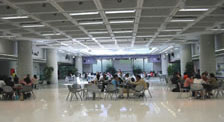
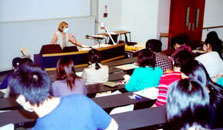
Rising to this challenging time, the Ad Hoc Group and the ARR" have drawn up a set of guidelines and made a number of additional logistic arrangements:
- All students should make sure that they do not exhibit any of the SARS symptoms, in particular a fever, before they attend any examinations. Those students who have come into close contact with one or more confirmed SARS patients within 10 days before an examination are required to be quarantined at home.
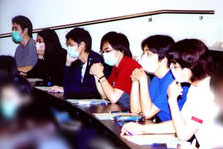
- Students who suspect they may have a fever or feel they need to have their body temperature taken can approach, between 9am and 6:30pm , the two specially set-up health counters, located at the covered terrace and at the Pedestrian Entrance, 3/F Academic Building.
- Invigilators will be asked to check the body temperature of those students at the Chan Tai Ho Multi-purpose Hall who show signs of fever, or who wish to take off their masks for a short while during examinations. They will be provided with a number of handheld infra-red temperature scanners. These devices were bought from a research institute in Shenzhen on 24 April, after University staff spent two busy days scrambling to track down available suppliers. The devices are small, lightweight and easy to operate. Best of all, they require no more than focusing a blip of infra-red light on a student's forehead, from four to six inches away. It requires less than two seconds for a reading and involving no skin contact with the student. Invigilators at the other venues are required to take students" temperatures, also on a need basis, using ear thermometers. The University has ordered 70 of these devices.
- Students who are found to have a body temperature exceeding 38 degrees Centigrade will be required to leave the examination venue. They will be given make-up examinations or equivalent forms of assessment later, with no adverse effects on their results.
- Students who sneeze or cough repeatedly during examinations will be asked to take their examinations in a corner of the room/hall or in a separate venue, after their body temperatures have been checked.
These arrangements have been specially drawn up for on-campus written examinations. Earlier, when classes resumed, the University encouraged academic staff to go for other forms of end-of-semester assessment, including take-home or on-line examinations, in the hope of alternating the demand on student workloads within a shortened period of time. Such alternative arrangements will also help to reduce the need for a large number of students to remain in a single venue for an extended period of time.
Despite these new arrangements, the University stresses that the Code of Student Conduct will still govern all forms of assessment. The quality of assessment is still stringently adhered to, even though a certain degree of flexibility has been introduced to its formats.