CityU helps secondary schools promote “Learning to Learn”
Shuyee Chen
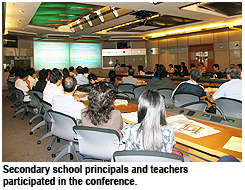
CityU is committed to promoting whole-person education. It has been nurturing self-regulated learners through the “Learning to learn” out-of-discipline course for a decade and in 2004 was sponsored by the Quality Education Fund to start the “Learning to Learn: Preparing Secondary School Students for Lifelong Learning” project, sharing the fruits of related research and experience with secondary school teachers and students. The project helps students develop the necessary attitude and skills to be self-regulated learners and provides training courses for secondary school teachers to master problem-based learning.

Dr Anna Kwan Siu-fong, the Project’s Principal Investigator and CityU’s Senior Education Development Officer, said problem-based learning emphasized problem-solving and critical thinking skills, particularly enhancing learners’ motivation to learn and helping them review their learning strategy on a regular basis. “It is useful to nurture skills that are essential for the challenges of a rapidly changing technology society and knowledge-based economy,” Dr Kwan said.
“The problem-based learning approach is student-oriented and provides room for self-regulated learning. It encourages students to take initiative to analyze problems and plan for their enquiries. It is best suited for teaching liberal studies and achieving learning to learn,” she added.
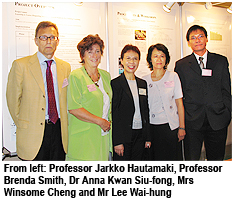
In the afternoon session, Mrs Winsome Cheng, Acting Assistant Principal of Wa Ying College, shared her experience in adopting problem-based learning for teaching the humanities. “It was a very good experience to show the way to prepare a school-based curriculum for training students to be independent and lifelong learners,” she said.
Meanwhile, Mr Lee Wai-hung from Fukien Secondary School (Siu Sai Wan) offered his experience in adopting the problem-based learning to teach liberal studies. “The course content for liberal studies is most suitable for adopting the problem-based learning. It helps students learn how to learn and take part on their own initiatives as well as to develop the skills essential to time management, problem solving and team work,” Mr Lee said.
Problem-based learning broadened the horizon of students and fostered students’ critical thinking through mutual questioning and evaluation, Mr Lee said.
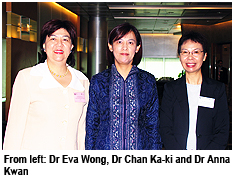
The Conference’s keynote speakers Professor Brenda Smith, from England, and Professor Jarkko Hautamaki, from Finland, gave speeches entitled “Offering the best learning experience: British Viewpoint” and “Evaluating students’ learning to learn ability: Finland’s experience”. Dr Chan Ka-ki, Principal Assistant Secretary (Curriculum Development Institute) with the Education Manpower Bureau, HKSAR, opened the event and presented certificates to teachers who completed the Facilitator Programme and Coordinator Programme of the Project.