Master of Science in Materials Engineering and Nanotechnology
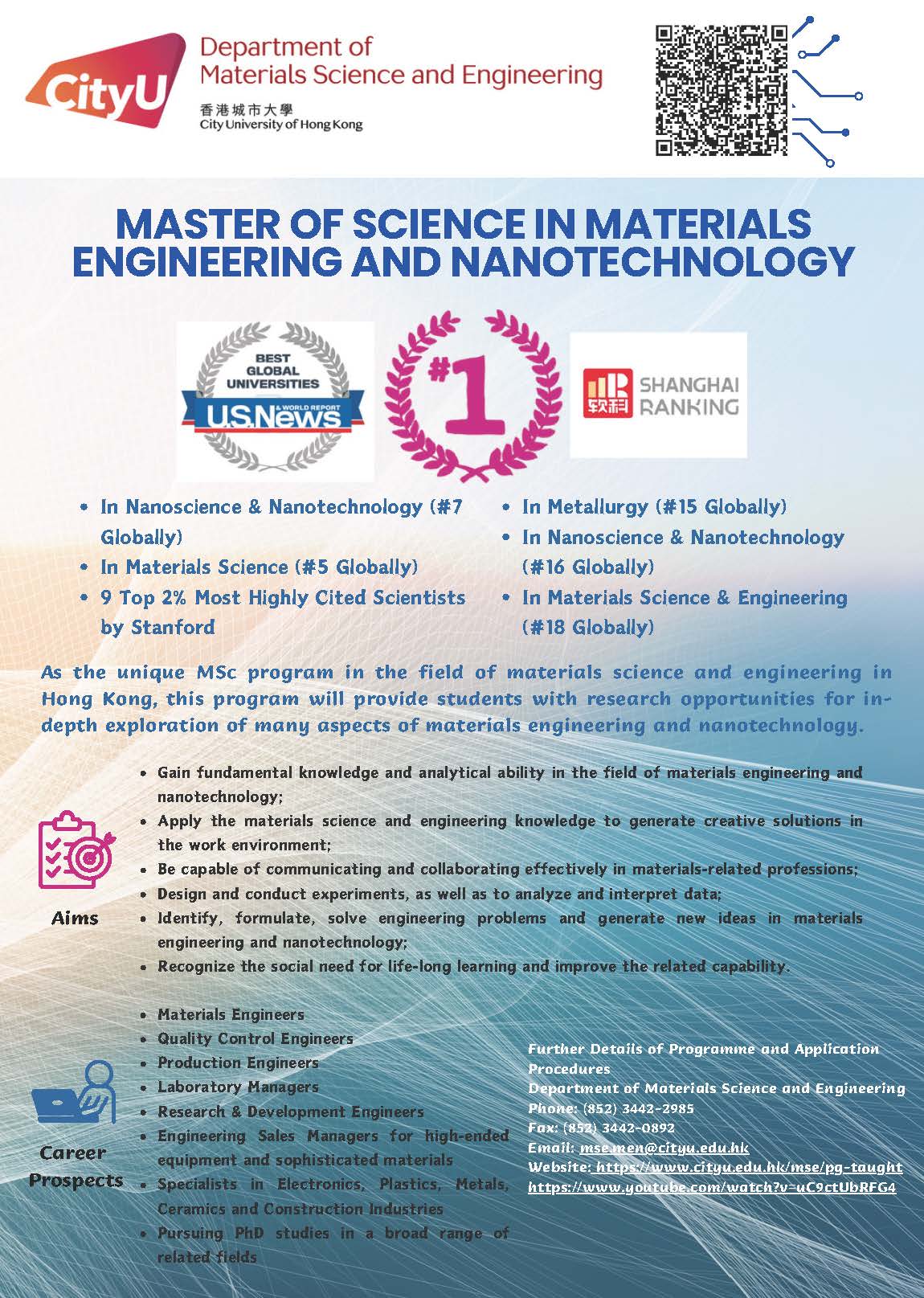
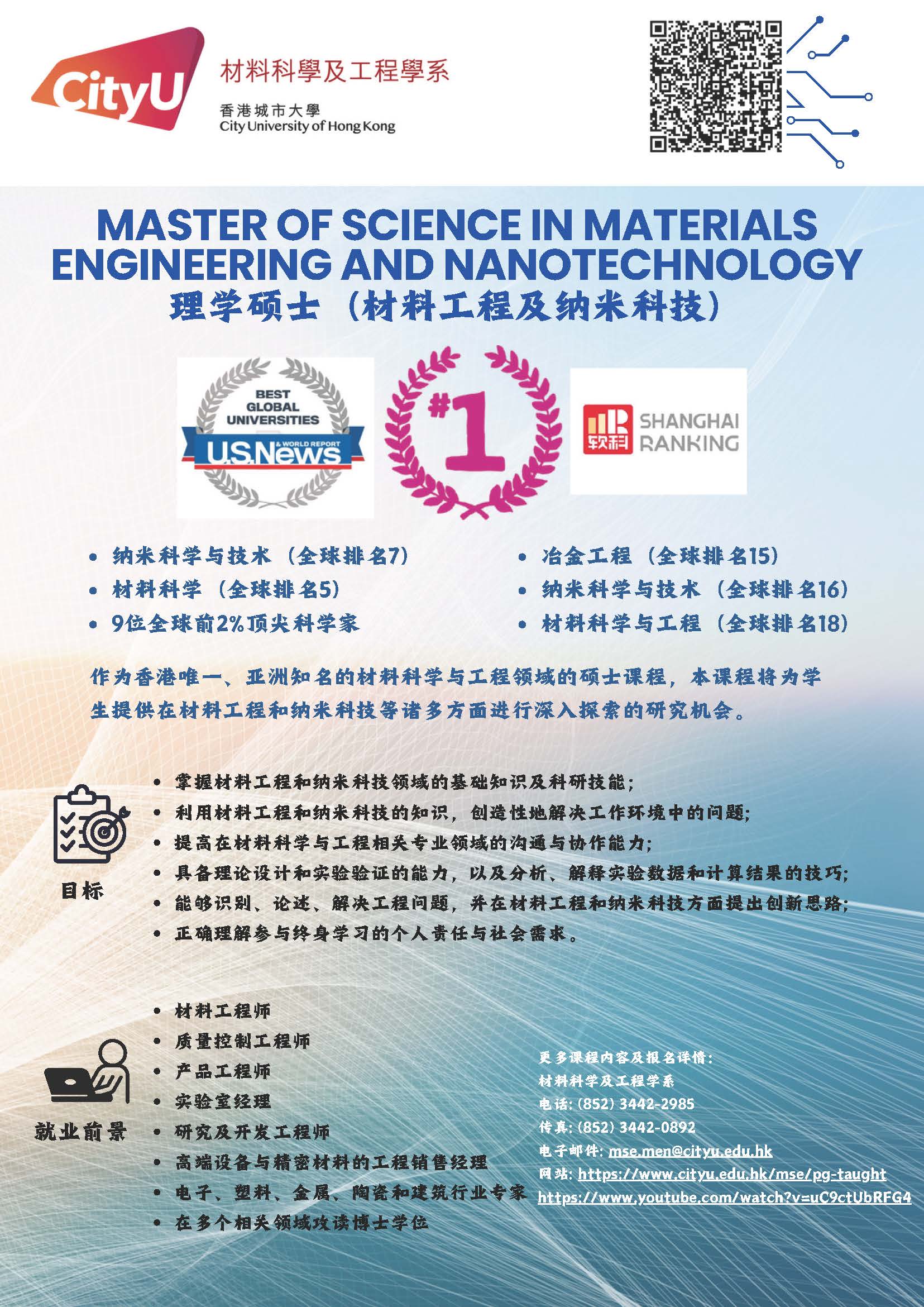
As the No. 1 programme (US News & Shanghai Rankings in Hong Kong) and a Top-20 programme (US News & Shanghai Rankings in the World) in the field of materials science and engineering, the programme provides an opportunity for applied scientists and engineers to pursue an in-depth study in various aspects of materials engineering and nanotechnology. Courses in this programme can also be used to fulfill the "top up courses" requirement for joining the Materials Discipline of the Hong Kong Institution of Engineers (HKIE).
| Programme | Master of Science in Materials Engineering and Nanotechnology 理學(xué)碩士(材料工程及納米科技) |
|---|---|
| Award Title | Master of Science in Materials Engineering and Nanotechnology 理學(xué)碩士(材料工程及納米科技) |
| Offering Academic Unit | Department of Materials Science and Engineering |
| Mode of Study | Combined mode |
| Programme Leader | Prof. LEI Dangyuan |
Programme Aims and Features
Designed to benefit students from a broad spectrum of academic background, the programme aims to enable students to:
- have extensive knowledge of and possess analytical ability in the field of materials engineering and nanotechnology;
- have the ability to apply the knowledge of materials engineering and nanotechnology to generate creative technical solutions in the working environment;
- be capable of communicating effectively in materials related professions;
- design and conduct experiments, and to analyze and interpret data;
- identify, formulate, solve engineering problems and generate new ideas in materials engineering and nanotechnology; and
- recognize the need for, and an ability to engage in life-long learning.
Research Opportunity
Top students with relatively higher GPA and suitable background can take the “Advanced Research” course (12 credit units), and have the opportunity to conduct world-class research using our sophisticated instruments.
Assessment and Progression
The assessment system consists of a combination of assessments in course work and written examination. The assessment criteria vary according to the different components of a course but students are provided with as many opportunities as possible to demonstrate their competence.
Course work consists of student performance in written assignments, tutorials, projects and laboratories. Formal written examination(s) are normally held at the end of each semester.
Professional Career Prospects:
- Materials Engineers & Scientists
- Quality Control Engineers
- Production Engineers
- Laboratory Managers
- Research & Development Engineers
- Engineering Sales Managers for high-ended equipment and sophisticated materials
- Specialists in Electronics, Semiconductors, EV batteries, Solar Cells, Catalysis, Biomaterials, Metals, Ceramics, Computational Materials, AI for Materials, and Construction
- Better prepared candidates for Ph.D. study in top universities.
Programme Structure
For student of 2021-22 Cohort and 2022-23 Cohort
For student of 2023-24 Cohort
For student of 2024-25 Cohort
For student of 2025-26 Cohort and Thereafter
| 1. Programme Core Courses: (9 credits) | |||
| Course Code | Course Title | Credit Units | Course Offering in 2025/26 Semester |
| MSE5301 | Instrumentation for Materials Characterization | 3 | A |
| MSE5303 | Structure and Deformation of Materials | 3 | A |
| MSE6265 | Quantum Theory of Semiconductors | 3 | A |
| 2. Programme Electives: (21 credits) | |||
| MSE5304 | Thermodynamics of Materials | 3 | B |
| MSE6121 | Thin Film Technology and Nanocrystalline Coatings | 3 | A |
| MSE6176 | Nanomaterials Design for Energy Applications | 3 | A |
| MSE6181 | Photonics in Nanomaterial Systems and Devices | 3 | A |
| MSE6182 | Polymers and composites and nano-applications | 3 | A |
| MSE6183 | Computational Methods for Materials Science | 3 | B |
| MSE6184 | Biomedical Materials and Devices with Nano-applications | 3 | B |
| MSE6185 | Advanced Structural Materials | 3 | B |
| MSE6266 | Semiconductor Materials and Devices | 3 | B |
| MSE6303 | Corrosion and Surface Engineering | 3 | B |
| MSE6309 | Advanced Research | 9 | Normally A and B |
| MSE8015 | Theory and Practice of TEM & Related Spectroscopy | 3 | B |
| MSE8020 | Structural Properties of Materials | 3 | A |
| MSE8021 | Kinetic and Thermodynamic Properties of Materials | 3 | B |
| The course syllabus is subject to change | |||
3. Additional Notes:
Intermediate and other awards:
Postgraduate Diploma in Materials Engineering and Nanotechnology (24 CUs)
深造文憑(材料工程及納米科技)
Postgraduate Certificate in Materials Engineering and Nanotechnology (12 CUs)
深造證書(材料工程及納米科技)
For the Postgraduate Diploma award, students are required to complete the three required courses (9 CUs) and 15 CUs electives to make up the total of 24 CUs.
Entrance requirement: same as Master of Science in Materials Engineering and Nanotechnology
For the Postgraduate Certificate award, students are required to complete the three required courses (9 CUs) and 3 CUs electives to make up the total of 12 CUs.
Entrance requirement: same as Master of Science in Materials Engineering and Nanotechnology
Admission
To be eligible for admission, you must satisfy the General Entrance Requirements, and you should normally have a degree in a relevant physical science or engineering discipline. For further details of admission requirements and application procedures, Click here for more information.
Related Links
Department of Materials Science and Engineering
Master's Programme