CityU team wins Gold Award at the Hong Kong Green Innovations Award for transforming manmade seawalls into living shorelines

The State Key Laboratory of Marine Pollution (SKLMP) at City University of Hong Kong (CityU) was awarded the prestigious Gold Award at the Hong Kong Green Innovations Award (HKGIA) as part of the 2022 Hong Kong Awards for Environmental Excellence (HKAEE). This recognition highlights the remarkable achievements of the CityU team in the field of green innovation. Organized by the Environmental Campaign Committee of the Hong Kong SAR (HKSAR) Government, the HKAEE is renowned as the city’s annual “Oscars of Environmental Protection.”

Led by Professor Kenneth Leung Mei-yee, Chair Professor in the Chemistry Department and Director of the SKLMP at CityU, the team comprises Dr Lo Chi-chiu, Thea Bradford, and Rainbow Leung, from the SKLMP, Dr Juan Carlos Astudillo, Assistant Professor in the School of Science and Technology at Hong Kong Metropolitan University, and Professor Poon Chi-sun, Chair Professor and Head of the Department of Civil and Environmental Engineering at The Hong Kong Polytechnic University. Their ground-breaking innovation, titled “Enhancing Intertidal Marine Biodiversity on Artificial Seawalls by Novel Eco-tiles”, clinched the top prize.
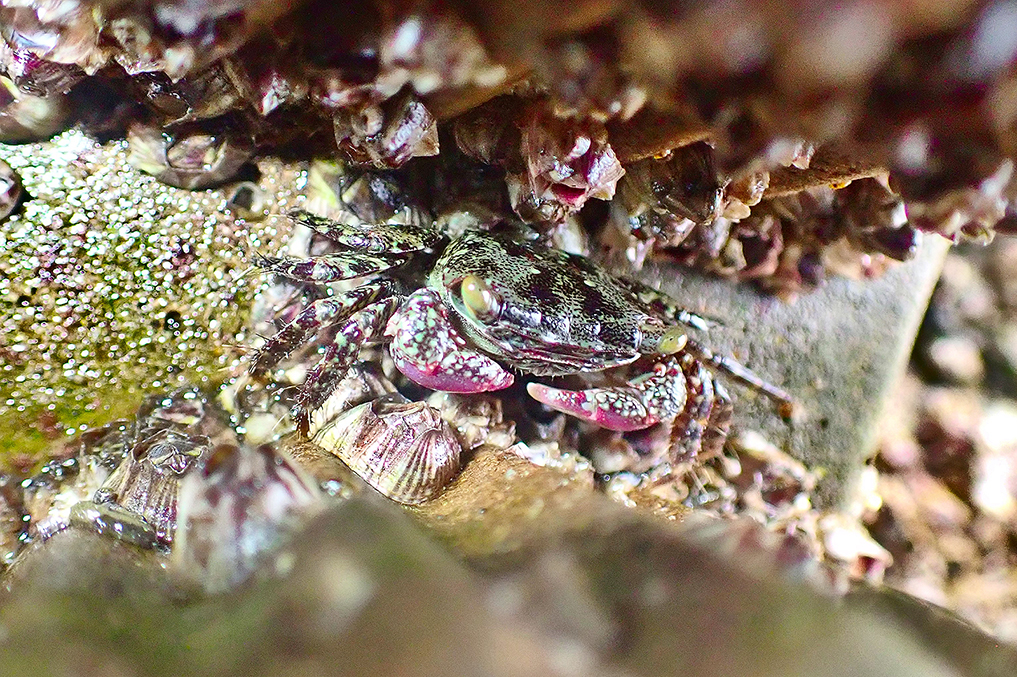
Conventional seawalls, typically made of concrete and granite boulders, lack the necessary structure to support the settlement and growth of marine organisms. The CityU team revolutionized the concept of seawalls with a two-fold innovation. First, they developed an eco-friendly concrete mix, comprising 40% waste materials, including fly ash from incineration of sludge (i.e., T×Park), and dredged marine sediment from navigation route maintenance. This novel concrete mix has high compressive strength (39 MPa) and low surface pH (about 10), which is crucial for sea defence structures and marine larval settlement, respectively. Second, incorporating ecological theory, the team created eco-tiles with water retention capacity and various microhabitats, such as grooves, holes and crevices of different sizes. These features not only offer refuge for marine life, but also effectively provide shade and lower temperatures during low tide in summer. Twelve-month trials conducted in Sai Kung, Ma Liu Shui and Tuen Mun demonstrated that the eco-tiles significantly reduced the average surface temperature by 2°C and increased species richness (biodiversity) by 80% compared to conventional seawalls.


Building on this success, the project team established a start-up called “afterNATURE” through CityU's innovation and entrepreneurship programme HK Tech 300 programme. Leveraging their expertise, they developed a range of eco-engineered products, including eco-tiles, eco-panels, tidal pools and eco-blocks, with a view to revitalising existing seawalls and breakwaters to enhance marine biodiversity and ecosystem services, thereby transforming manmade seawalls into living shorelines. These products have been adopted by the HKSAR Government for numerous local seawalls in Causeway Bay and Tsuen Wan, and on Lamma Island, among others. More recently, their products have gained traction in coastal restoration projects in Mainland China, Korea, and the United States.
“I’m delighted to receive this recognition alongside the team,” said Professor Leung. “The HKGIA is significant affirmation of our research efforts in ecological restoration and our support for the HKSAR Government in implementing eco-shorelines to enhance marine biodiversity. By utilizing waste materials in our eco-tiles, we minimize cement usage and reduce the carbon footprint. Transforming waste into useful products for ecosystem restoration also helps reduce waste disposal and extends the service life of landfills.”
Professor Leung expressed his sincere gratitude to the Development Bureau and the Civil Engineering and Development Department of the HKSAR Government for their trust, long-term partnership, financial support, and logistical assistance in facilitating trials of their products on local seawalls. Their support has been instrumental in fostering creativity and continuous improvement along this research and development journey, he added.
In addition to the HKGIA, the team's eco-tile invention has received several international accolades this year, including the Special Prize (Prize of the Korea Invention Promotion Association), the Gold Medal with Congratulations from the Jury at the 48th Geneva International Exhibition of Invention in Geneva, Switzerland, and the Gold Medal in the Asia International Innovative Award at the Asia International Innovative Invention Exhibition, held in Hong Kong, China.