About 100 teachers and students from local secondary schools gathered at CityU to share their experiences implementing problem-based learning (PBL) in their classrooms. The seminar, part of the 2005
Teachers’ Update Course and entitled “Helping secondary school students become lifelong learners: Implementing PBL in schools”, took place on 2 July as part of the
Learning to Learn: Preparing Students for Lifelong Learning project, funded by the Quality Education Fund (QEF) and led by
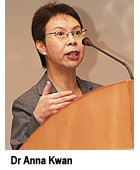
Dr Anna Kwan of CityU’s
Education Development Office.
At the seminar, held in the Multi-media Conference Room, six secondary school teachers and administrators who had attended the training session
A Learning to Learn Facilitator Programme for Secondary School Teachers in March at CityU, discussed how they practiced PBL in their schools and the feasibilities of applying PBL to liberal studies and other subjects in secondary schools.
Science teacher
Mr Lo Siu-kit, from Daughters of Mary Help of Christians Siu Ming Catholic Secondary School, said his students responded positively to PBL. “In just three months, my students learnt how to choose what they wanted to learn and tried to find out answers by themselves. PBL encourages the students to take initiatives and enjoy the learning experience. This has made learning and teaching much more effective.” In his opinion, teachers’ workload would not increase too much if they could master PBL skills.
Mrs Winsome Cheng, Deputy Principal of Wa Ying College, said PBL was a systematic method that could be applied in secondary schools. “The results are very positive for both teachers and students,” she said. “Teachers have found new ways of teaching, students get more involved in the learning process, and students’ communication skills and team spirit have improved significantly.”
Mrs Cheng herself got new insights for teaching and curriculum development from PBL. She believed PBL was in line with the spirit of liberal studies and could help students think independently and critically, and thus prepare them to embrace future studies.
A colleague of Mrs Cheng, Mr Chow Wing-ho, said: “We conducted surveys before and after introducing PBL. The results were very encouraging. All participating students have made progress – those who in the past have not performed well have improved greatly,” he said.
Mr Cheng Ming-leong, a teacher of St Clare’s Girls’ School, witnessed the benefits of PBL during his postgraduate studies, and therefore enthusiastically applied it to his teaching. “Stimulated by an active and interactive learning environment, we can see and feel the real changes in the students. Not only have students played a more active role in class which has in turn created a more dynamic atmosphere, but they can now formulate more complex and challenging questions,” he said.
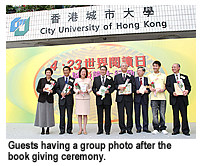
The guest of honour Dr K K Chan, Principal Assistant Secretary (Curriculum Development) of the Education and Manpower Bureau, presented certificates to teachers who had completed the three-day programme, A Learning to Learn Facilitator Programme for Secondary School Teachers.
Dr Kwan, the Principal Investigator of the
Learning to Learn: Preparing Students for Lifelong Learning project, has been engaged in education for more than 20 years. About ten years ago she started to develop and transform a
Learning to Learn course at CityU and to conduct relevant research work and teacher training. According to her, PBL is an important method to help students learn to learn because it emphasizes active learning, encourages students to take the initiative in the learning process, trains students’ observation and critical thinking skills, and broadens their knowledge base.
“Though PBL originates from universities, it is not exclusive to higher education. In fact, it can be applied in secondary and even elementary schools, and in all kinds of subjects,” Dr Kwan said, adding that in the present information-rich era, it is more important to teach students to fish, than to feed them fishes.
The two-year Learning to Learn: Preparing Students for Lifelong Learning QEF project led by Dr. Kwan will be completed by 2006. The project aims to strengthen teachers’ understanding in PBL, and help teachers master PBL skills in order to improve the traditional classroom teaching methods. PBL helps create an environment in which students can master how to build experiences and become a lifelong learner to cope with the challenges in the future.
CityU is committed to strengthening links with secondary schools in order to develop quality education in Hong Kong. The University actively promotes PBL in secondary schools and has trained more than a thousand teachers in this area. CityU set up a credit-bearing Learning to Learn course ten years ago to nurture ideal graduates who are willing to engage in lifelong learning.